
GMT Watches: The Complete 2026 Guide to Dual-Time and Travel Timepieces
In an increasingly connected world where business meetings span Tokyo, London, and New York in a single day, knowing the time across multiple zones is no longer a luxury — it is a necessity. GMT watches, short for Greenwich Mean Time watches, have evolved from niche pilot instruments into essential tools for global travelers, remote workers, and watch enthusiasts alike. This comprehensive guide explores everything you need to know about GMT watches in 2026, from their fascinating history to the best models available today.
What Is a GMT Watch?
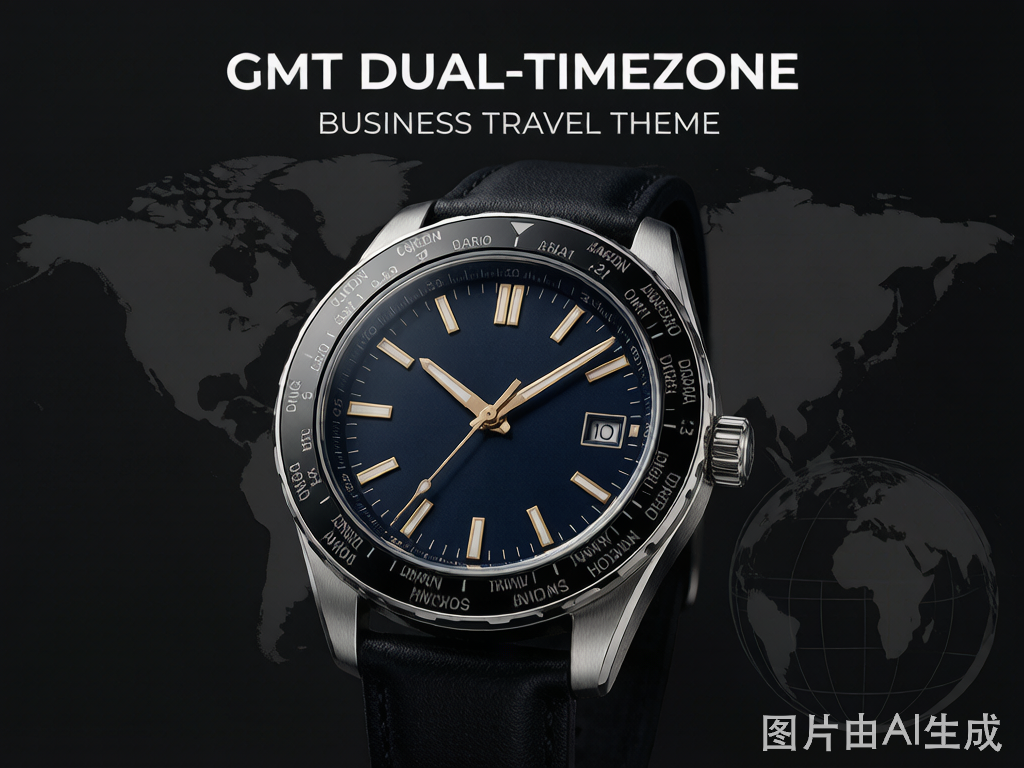
A GMT watch is a timepiece that displays the time in two or more time zones simultaneously. The defining feature is an additional hour hand — often shaped like an arrow or triangle — that completes one rotation every 24 hours rather than every 12. This fourth hand points to a 24-hour scale, typically printed on the bezel or an inner ring, allowing the wearer to track a second time zone at a glance.
The concept is elegantly simple: your main hour hands show local time in 12-hour format, while the GMT hand shows home time or the time in another zone in 24-hour format. This 24-hour indication eliminates the AM/PM ambiguity that can cause embarrassing 3:00 AM phone calls to colleagues on the other side of the world.
The History of GMT Watches
The Rolex GMT-Master: Born from Aviation
The story of GMT watches begins in 1954, when Pan American Airways approached Rolex with a specific problem. As commercial aviation expanded, pilots and navigators needed a reliable way to track both local time and Greenwich Mean Time (the standard for aviation communications). Rolex responded with the Rolex GMT-Master, reference 6542, featuring a fourth hand and a rotatable 24-hour bezel with a distinctive red and blue “Pepsi” color scheme.
The GMT-Master was revolutionary. Its bicolor bezel allowed pilots to distinguish daytime from nighttime hours in the second time zone at a glance. The red half represented daytime hours (6 AM to 6 PM), while the blue half represented nighttime hours (6 PM to 6 AM). This design has become so iconic that “Pepsi” is now synonymous with GMT watches in the horological community.
From Cockpit to Wrist: The GMT Goes Mainstream
While the GMT-Master was designed for pilots, it quickly found favor with business travelers, diplomats, and anyone who regularly communicated across time zones. Other manufacturers took notice. Glycine introduced the Airman in 1953 — actually predating the Rolex — with a 24-hour dial and locking bezel. Throughout the 1960s and 1970s, brands like Omega with the Seamaster GMT and Grand Seiko with their own GMT models expanded the category.
For a deeper dive into how watch technology has evolved over the decades, including the rise of mechanical watch complications, our related guide covers the renaissance of automatic timepieces.
How Does a GMT Movement Work?
Understanding the mechanics behind a GMT watch helps appreciate the engineering involved. There are two primary approaches to implementing a GMT function:
The “True GMT” (Caller GMT) Approach
In a true GMT movement, the local hour hand can be adjusted independently in one-hour increments, usually via the crown. The GMT hand and the 24-hour bezel remain set to home time. This design is ideal for travelers: when you land in a new time zone, you simply jump the local hour hand forward or backward without stopping the watch or disturbing the GMT hand.
This is the approach used by the Rolex GMT-Master II, Tudor Black Bay GMT, and many premium GMT models. It requires a more complex movement architecture, which is why true GMT watches tend to be more expensive.
The “Office GMT” (Flyer GMT) Approach
In an Office GMT movement, the GMT hand is the one that can be adjusted independently, while the local hour hand moves continuously with the main timekeeping mechanism. This is simpler and less expensive to manufacture but less convenient for travelers, as adjusting the local time requires stopping the entire movement.
Many affordable GMT watches use this approach, including some models from Seiko and various microbrands. While less practical for frequent flyers, they are perfectly adequate for people who want to track a distant time zone from their desk.
If you are interested in different movement types beyond GMT complications, our watch movement types guide provides a comprehensive overview of automatic, quartz, solar, and hybrid mechanisms.
Key Features to Look for in a GMT Watch
1. Rotating vs. Fixed Bezel
A rotating 24-hour bezel adds tremendous versatility. By rotating the bezel, you can track a third time zone — useful for people who work with teams in multiple regions. Fixed bezels, on the other hand, are simpler and often more durable, making them suitable for those who only need to track two zones.
2. Bezel Material and Construction
Bezel material affects both durability and aesthetics. Ceramic bezels, popularized by Rolex’s Cerachrom, offer exceptional scratch resistance and color stability. Aluminum bezels are lighter and less expensive but can scratch and fade over time. For a detailed comparison of watch case and bezel materials, see our luxury watch materials guide.
3. Movement Quality
The movement is the heart of any watch, and GMT movements are particularly complex. Look for movements from reputable manufacturers — ETA, Sellita, Miyota, or in-house calibers from established brands. The power reserve, accuracy rating, and jewel count all indicate movement quality.
4. Legibility
A GMT watch must be readable at a glance, often in challenging conditions. Look for:
- Luminous hands and markers for nighttime visibility
- Distinctive GMT hand color (often red, orange, or yellow) to differentiate from the main hands
- Clear 24-hour scale with adequate spacing between numbers
- Anti-reflective coating on the crystal to reduce glare
5. Water Resistance
Travel often involves swimming pools, ocean visits, and unexpected downpours. A water resistance rating of at least 100 meters (10 ATM) is recommended for a travel watch. Our waterproof watches guide explains ATM ratings in detail.
The Best GMT Watches in 2026
Entry-Level GMT Watches (Under $500)
Seiko 5 Sports GMT: The SSK series brought true GMT functionality to the masses. With an in-house 4R34 movement, rotating bezel, and the reliability Seiko is known for, this is arguably the best entry-level GMT watch available. The SKX-style case design appeals to both new collectors and seasoned enthusiasts.
Citizen Promaster GMT: Combining solar Eco-Drive technology with GMT functionality, this model offers excellent value. The Super Titanium case is lightweight and scratch-resistant, making it ideal for frequent travelers.
Mid-Range GMT Watches ($500–$3,000)
Tudor Black Bay GMT: Often called the “everyman’s GMT-Master,” this watch offers a true GMT movement, 70-hour power reserve, and that iconic Pepsi bezel — all at a fraction of the Rolex price. The MT5652 movement is COSC-certified for chronometer accuracy.
Hamilton Khaki Aviation GMT: With its pilot watch heritage and reliable Swiss automatic movement, Hamilton offers excellent value in the mid-range segment. The clean, legible dial design makes it a versatile choice for both business and casual wear.
High-End GMT Watches ($3,000+)
Rolex GMT-Master II: The gold standard of GMT watches. The latest versions feature the Caliber 3285 movement with a 70-hour power reserve, Chronergy escapement, and Parachrom hairspring. Whether in stainless steel, two-tone, or precious metal, the GMT-Master II remains the benchmark.
Grand Seiko GMT: Grand Seiko brings Japanese precision to the GMT category. The Spring Drive GMT models offer ±1 second per day accuracy and a sweeping seconds hand that glides with mesmerizing smoothness. The Zaratsu-polished cases are works of art in their own right.
For business professionals who travel frequently, a GMT watch pairs beautifully with formal attire. Our business watches guide offers additional recommendations for executive timepieces.
GMT Watches vs. World Timers: What’s the Difference?
While both GMT watches and world timers track multiple time zones, they differ significantly in approach:
- GMT watches typically track two time zones (three with a rotating bezel) and use a dedicated 24-hour hand
- World timers display all 24 time zones simultaneously on a rotating city ring and 24-hour disc
- GMT watches are generally more legible and easier to adjust
- World timers excel at quickly checking the time anywhere in the world but can be visually busy
For most travelers, a GMT watch is the more practical choice. World timers are better suited for those who work with global teams across many time zones simultaneously.
Setting and Using Your GMT Watch
Setting a True GMT (Caller GMT)
- Pull the crown to position 2 and set the local time using the main hour and minute hands
- Pull the crown to position 3 and set the GMT hand to your home time zone using the 24-hour scale
- Push the crown back in and screw it down if applicable
- When traveling, use position 2 to jump the local hour hand without stopping the movement
Setting an Office GMT (Flyer GMT)
- Pull the crown to the time-setting position and set the local time
- Use the GMT quick-set function (usually a crown position or pusher) to set the GMT hand
- The bezel can be rotated to track a third time zone if needed
Caring for Your GMT Watch
GMT watches contain more complex movements than standard three-hand watches, so proper maintenance is essential:
- Service the movement every 4-5 years for mechanical GMT watches
- Avoid exposing the watch to strong magnetic fields, which can affect the GMT hand’s accuracy
- Rinse with fresh water after exposure to saltwater or chlorine
- Store in a watch winder if you want the GMT hand to maintain home time when not worn
- Have the water resistance checked annually if you swim regularly
Proper care extends the life of any timepiece. For comprehensive maintenance advice, and to understand why classic watches can last decades with proper care, our related articles provide additional insights.
Why GMT Watches Matter in 2026
In an era of smartphones and digital clocks, you might wonder why anyone needs a mechanical GMT watch. The answer lies in three key areas:
Convenience and Discretion
Glancing at your wrist to check a colleague’s time zone is faster and more discreet than pulling out your phone, especially during meetings or social events. A GMT watch conveys professionalism and global awareness without saying a word.
Reliability
A mechanical GMT watch does not depend on batteries, cellular service, or software updates. It will work on a transatlantic flight, in a remote location, or during a power outage — making it a dependable backup to digital devices.
Style and Heritage
GMT watches carry the romance of mid-century aviation, the golden age of air travel, and the romance of global exploration. Wearing one connects you to that legacy in a way no smartwatch can replicate. For those interested in how traditional watchmaking coexists with smart technology, our smart watch market analysis explores this fascinating intersection.
Frequently Asked Questions
Can I track three time zones with a GMT watch?
Yes, if your GMT watch has a rotating 24-hour bezel. Set the GMT hand to home time, the main hands to local time, and rotate the bezel to align with a third zone’s offset.
Are GMT watches only for pilots?
No. While they originated as pilot’s tools, GMT watches are now popular with business travelers, remote workers, expatriates, and anyone who communicates across time zones regularly.
Is a true GMT worth the extra cost?
For frequent travelers, absolutely. The ability to jump the local hour hand without stopping the movement is a significant convenience. For those who rarely change time zones, an Office GMT may suffice.
Conclusion
GMT watches represent one of the most practical complications in horology. They combine mechanical ingenuity with real-world utility, bridging the gap between tool watch and luxury timepiece. Whether you are a frequent flyer navigating global business hours, a remote worker coordinating with international teams, or simply a watch enthusiast who appreciates mechanical complexity, a GMT watch is an investment that pays dividends in both function and style.
As the world becomes more interconnected, the GMT complication grows only more relevant. In 2026, with remote work and global collaboration at all-time highs, there has never been a better time to add a dual-time watch to your collection. Explore our range of wholesale watches to find GMT models that suit your needs and budget.
Related Articles
- Best Business Watches for Men: The Executive’s Complete Guide
- Watch Movement Types Explained: Automatic, Quartz, Solar & Hybrid
- Luxury Watch Materials Explained: Stainless Steel, Titanium, Ceramic & Gold
- Waterproof Watches Explained: ATM Ratings & Water Resistance Guide
- Classic Watches: Why One Timepiece Can Take You From Office to Weekend
- Smart Watches in 2026: Market Growth & Buying Guide
- Wholesale Watches from China: The Smart Business Move
Leave a Reply